2018 Meeting Minutes

Lake Independence Citizens Association

Making Waves Towards a Cleaner Lake
Lake Independence is a beautiful recreational lake in Western Hennepin County, Minnesota.
Birds of Lake Independence:
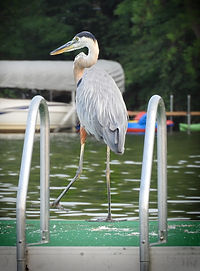
Great Blue Heron

HABITAT:The Great Blue Heron is the largest heron native to North America. They are present in Minnesota from March through October and winter along the ice-free coasts and watercourses of southeastern United States and the Caribbean. Most live about 15 years in the wild, though some have been recorded surviving over 24 years.
PHYSICAL DESCRIPTION: Adults are 38″ to 54″ long, weigh 74 to 88 ounces, and have a wingspan of about 7′. Males are slightly larger than females.
The wings and back are bluish-gray except for a black shoulder patch. The legs are long, stilt-like, and dark gray except for chestnut brown feathers on the thighs. The chest and belly are whitish. The neck is long and curving. It is grayish-blue on the back, whitish underneath, and with white, black, and rust-brown. The eyes are yellow. The bill is long, straight, and yellow. The face is white with a black stripe extending from the bill to the back of the head. During Breeding season both males and females develop long, slender, black plumes extending from the back of the head and long plumes extending from the body at the neck, breast, and back. In flight, the neck is folded over the body in an S-curve and the legs trail behind the body.
NESTING: Great Blue Herons typically breed in colonies of a few to a few hundred nesting pairs. They are serially monogamous, remaining with one partner throughout the Breeding season but choosing a new partner each season. They produce one brood per season.
The male selects a site, usually at the top of a tree, often the same site used the previous year, and attracts a passing female. Together they build the nest, the male gathering materials, the female weaving the materials into a platform nest. Often a fresh layer is added to a nest from a previous season. The female lays usually 4, but as few as 2 or as many as 7, pale blue eggs. The eggs hatch after 26 to 30 days. The young leave the nest after 60 to 81 days.
FOOD:Mostly small fish but also amphibians, reptiles, small mammals, dragonflies, grasshoppers, crayfish, and other aquatic invertebrates.
The Minnesota Connection
-
Seasonal Residents: According to the Minnesota Breeding Bird Atlas, they are regular breeding residents, arriving in March as ice melts and migrating south by October.
-
Famous Local Colonies: They gather in high-density communal nesting areas called rookeries. Famous Minnesota viewing locations include the Pelican Lake Heron Rookery and various islands along the Mississippi River.
-
Winter Exceptions: While most migrate, a few hardy individuals regularly overwinter in Minnesota near ice-free, fast-moving streams in the southeast portion of the state.
💡 Fascinating Facts
-
Lightning-Fast Hunters: They stand perfectly still in shallow water before using their dagger-like bills to strike fish, frogs, and snakes with specialized neck vertebrae that act like a coiled spring.
-
Skilled Mechanics: During courtship, the male gathers sticks and presents them to the female, who weaves them into a large nest platform measuring up to 3 or 4 feet across.
-
High-Altitude Neighborhoods: Their rookeries can feature dozens of nests packed tightly into the upper canopy of a single grove of trees, often high above the water to avoid land predators.
-
Preen and Clean: They have unique "powder down" feathers on their chest. They crush these feathers with their feet to create a powder that absorbs slime and fish oil, then scrape it off using a specialized fringed claw on their middle toe.

DNR Approves New High-Water Ordinance for Lake Independence
LICA has been notified that the Minnesota DNR has approved the new high-water ordinance proposed by the Cities of Independence and Medina for Lake Independence, calling it a “measured and reasonable response” to high-water conditions.
The approved ordinance establishes a two-stage approach:
At 958.2 ft: Slow No Wake will be required within 600 feet of shore, while normal boating may continue in the center of the lake.
At 959.2 ft: A Slow No Wake restriction will take effect across the entire lake.
LICA supports the addition of the 600-foot Slow No Wake zone to help protect shorelines and lakeshore property during periods of high water. LICA also strongly advocated for an extreme high-water trigger that would place the entire lake under a Slow No Wake restriction. We are pleased that the Cities included this important additional safeguard in the new ordinance. While the final trigger level is higher than LICA had recommended, its inclusion provides an added level of protection for Lake Independence during periods of exceptionally high water.
The DNR formally approved the proposed ordinance on August 27, 2026. The cities can now move forward with final adoption. Click here to read the new ordinance.

Gorgeous Fall Color!
Take a look into Lake Independence's past!
Click on image to see all 26 pictures!

2026 Calendar of Events
Party on the Ice
Saturday, February 21
**Ice Clean-up Day** CANCELLED
Sunday, March 8
Annual Members Meeting
Camp Ihduhapi
Saturday, April 25, 1PM
4th of July Flotilla
Saturday, July 4, 1:00 PM
Oktoberfest Picnic
Baker Park Driftwood Shelter
Saturday, October 3, 11:30 AM